

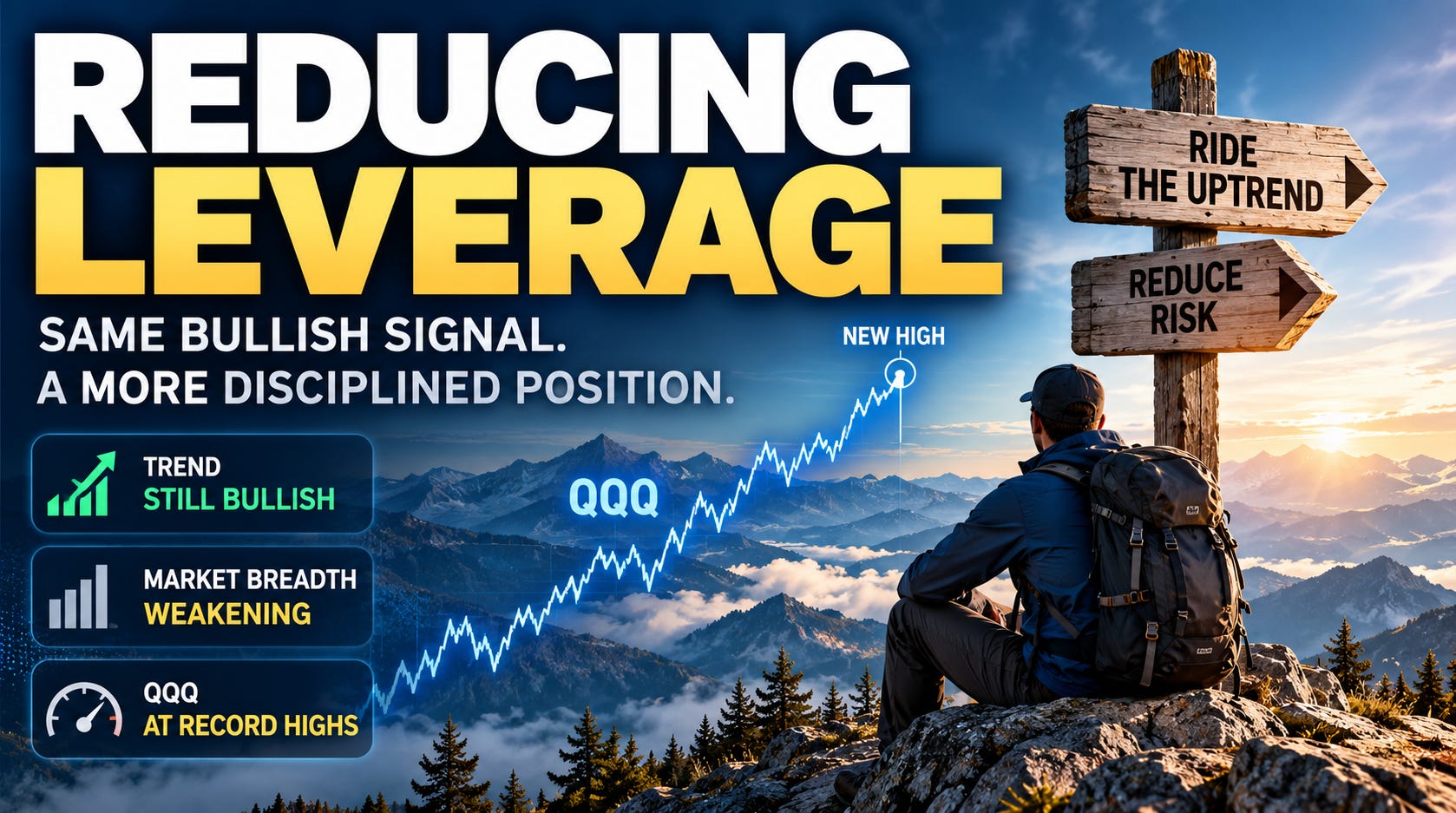
My signal is still on BUY, and it has been since April 2.
QQQ is at record highs, the trend remains strong, and I’m not trying to call a market top. In fact, my historical data suggests that new highs during a BUY signal have tended to stay bullish.
But there’s a difference between staying invested and carrying more leverage than I need.
Over the past few months, my leverage has crept up. My portfolio now has approximately 1.86x market exposure. That’s contributed to the large swings you’ve seen in my updates this year—both up and down.
At the same time, this rally is unusually narrow. When QQQ made its first new high in sixteen weeks on September 22, fewer than half of Nasdaq-100 stocks were trading above their 50-day moving averages—by one measure, the weakest participation on any record day since 2016. Across the S&P 500, only about 49% of stocks were above their 200-day averages, down from roughly 70% at the end of July.
That doesn’t mean a correction is imminent. It does mean a handful of leaders are doing most of the lifting, and I don’t think this is the time to carry maximum leverage.
So I’m making one change.
Why Reduce Leverage Now?
My QQQ signal remains bullish, and momentum is still positive. That’s why I’m not exiting the uptrend.
But current conditions are less attractive for carrying nearly 2x portfolio exposure:
Signal: BUY
Trend: Still bullish
QQQ: At record highs, about 13% above its 200-day moving average
Momentum: Strong (RSI near 70)
Market breadth: Weak—gains concentrated in a few leaders
Portfolio exposure: ~1.86x
Historically, conditions like these have not been reliable sell signals. Markets can keep climbing while overbought and narrow.
But they can also become more vulnerable to sharp pullbacks.
That’s an important distinction.
I want to keep riding the trend. I just don’t need maximum leverage to do it.
What My Backtest Says
When I tested my QQQ signal from 2001 to today, the exposure level changed the risk dramatically:
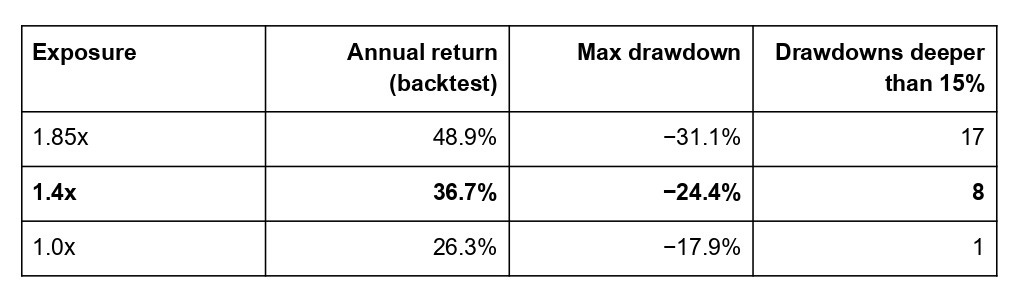
Backtest of my QQQ timing signal at fixed exposure levels, Jan. 2001–Oct. 2026, reset daily like a leveraged ETF. Includes estimated leveraged-ETF costs: financing on exposure above 1x plus a 0.9% expense ratio. Excludes commissions, taxes, and interest on cash. Hypothetical; past results don’t guarantee future returns.
Cutting exposure from roughly 1.85x to 1.4x gives up some hypothetical return in the backtest, but it cuts the number of drawdowns deeper than 15% by more than half.
At this stage, that’s a trade-off I’m comfortable making.
Big drawdowns hurt compounding even when the underlying signal ultimately proves right.
Below is exactly what I’m doing.
Subscribe free to unlock my live portfolio update