

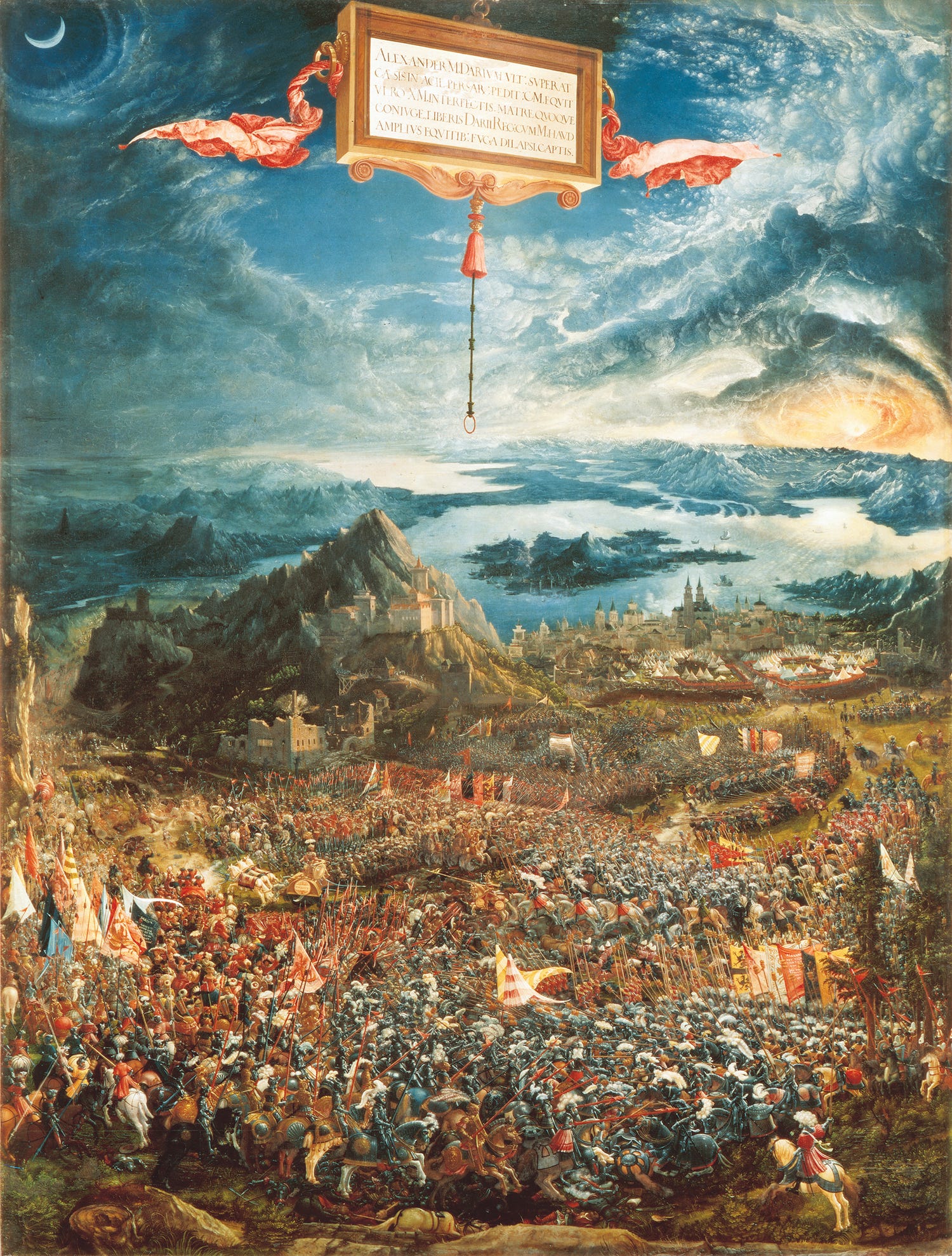
Albrecht Altdorfer, "The Battle of Alexander at Issus" (1529). Alte Pinakothek, Munich.
No pick today. This is the human story behind every rule in the Core-Plus system — the market-timing signal, the position caps, the no-discretion mandate. None of those rules are arbitrary. Every one of them exists because of stories exactly like this one.
In the autumn of 325 BC, Alexander the Great stood at the edge of the Gedrosian Desert, having just conquered more of the known world than anyone in history — and he was still only in his late twenties. Ten years of unbroken victory lay behind him — Persia fallen, Egypt his, an empire stretching from Greece to the Indus. His own men had begged him to turn back at the Hyphasis River, exhausted and homesick, and for once he’d relented. But rather than take the safer inland road home, Alexander chose to march his army straight through one of the most lethal deserts on earth — partly to resupply his fleet, partly, historians agree, to outdo the legendary conquerors before him who had tried and failed to cross it. He wanted to be the first.
He was almost the last. The sixty-day crossing became a catastrophe: no reliable water, flash floods that drowned camp followers in their sleep, soldiers and pack animals collapsing from heat and thirst by the thousands. Estimates of the dead range as high as three-quarters of the column that entered the desert. A young commander who had never lost a battle nearly destroyed his own army not through enemy action, but through the same audacity that had built his empire in the first place.
That’s the pattern worth sitting with. It isn’t really about deserts, or crypto, or hedge funds. It’s about what a young person’s unbroken success does to judgment — how being right, fast, again and again, can convince you that boldness itself is the strategy, and that the normal rules of caution were written for slower, older, lesser minds.
Sam Bankman-Fried and Leopold Aschenbrenner each lived a twenty-first-century version of that pattern: two extraordinarily young minds who moved with real speed and real insight, whose youth was their edge, and who ran, at the peak of their success, straight into their own Gedrosian Desert. To be direct about it upfront: their outcomes were not the same, and this piece doesn't argue they were — one man was convicted of fraud, the other has not been accused of any wrongdoing. What they share is the psychological pattern that preceded the collapse, not the collapse itself.
The investor’s version
Every investor knows a smaller version of this story from the inside.
You find an idea you believe in. You test it with a little money, and it works — fast. That first win turns a hypothesis into a conviction, so you add more, then more again, each addition justified by the last one paying off. Somewhere in there, a bet starts feeling like a strategy.
Then leverage enters, because conviction that strong looks foolish left un-levered. Your account grows in a way that stops resembling investing and starts resembling vindication. A major share of your net worth ends up riding on one idea, and the idea has been right for so long that risk starts to feel like a formality.
Then, for reasons that always feel unfair in the moment, the thesis stalls. Because you’re levered, the drawdown isn’t proportional to how wrong you were — it’s amplified by how much borrowed conviction you were carrying. Margin calls arrive on their own schedule, not yours. The music stops, and the portfolio you thought reflected how right you’d been actually just reflected how much you’d bet on staying right forever.
This isn’t a story about bad investors. It happens to people whose early read was genuinely good — which is exactly what makes the lesson easy to miss. It also happens disproportionately to young investors, because youth comes with a shorter memory of past cycles and a longer runway of time to feel invincible in. Do it with a personal account and you get a bad year. Do it with billions of other people’s dollars, at twenty-nine or twenty-four, and you get Sam Bankman-Fried and Leopold Aschenbrenner.
The boy who did the math
Bankman-Fried’s story was always a little too clean: a Jane Street trader turned effective altruist, running expected-value calculations on human suffering, concluding that the moral thing to do was get rich fast and give it away faster. He was still in his twenties when he built it. If you believe the odds favor you and the upside is measured in lives saved, caution starts to look like a moral failure. FTX went from scrappy exchange to a firm valued in the tens of billions in barely two years, with Bankman-Fried becoming, on paper, one of the youngest self-made billionaires alive — the same audacity that let a twenty-something outmaneuver Wall Street veterans also convinced him the normal guardrails didn’t apply to him.
That speed was the tell.
When a twenty-something’s models keep printing money, the conclusion isn’t “I got lucky” — it’s “I understand something others don’t.”
Alameda Research reportedly operated with a secret, effectively unlimited line of credit at FTX — reporting has put the exempted borrowing limit as high as $65 billion — and by September 2022 had drawn roughly $14 billion of customer funds against it, largely uncollateralized. That isn’t leverage in the conventional sense of margin against posted collateral; it’s closer to trading with someone else’s money with no real ceiling at all, which made the eventual hole impossible to paper over once confidence in the FTT token collapsed. A jury saw fraud, not philosophy.
What’s striking is that he seems to have believed his own model of himself — smart enough, righteous enough, young enough to see further than everyone older and more cautious around him.
That belief isn’t lying. It’s forgetting you can be wrong.
The essay that became a fund
Leopold Aschenbrenner’s path looks nothing like SBF’s, which is exactly what makes it worth placing alongside it. A German-born prodigy who entered Columbia at 15 and graduated valedictorian at 19, he worked on OpenAI’s Superalignment team before being pushed out in 2024. He turned the experience into “Situational Awareness,” an essay arguing AI matching human intelligence would arrive by decade’s end, and that markets were badly underpricing the implications — written and published before he’d turned 24.
The essay made him famous. Then, still in his mid-twenties, he raised a hedge fund built entirely around trading that thesis — and for a while it worked spectacularly, swelling to tens of billions of dollars as AI infrastructure stocks soared, with Aschenbrenner treated less like a fund manager than an oracle with a spreadsheet. It’s a very young person’s move: skip the decades of apprenticeship a fund manager traditionally serves and bet that raw conviction, arrived at fast, can substitute for experience.
Then, in late July, a sharp selloff in AI infrastructure names triggered margin calls his fund couldn’t easily meet. Reports put some of Situational Awareness’s positions at roughly 4x leverage — meaning a given stock’s move was felt four times over in the fund’s returns.¹ That leverage had been the engine of the fund’s rise, reportedly gaining more than 400% after fees through June; it became the engine of its collapse, as the portfolio fell an estimated 67% in July alone, with total assets sliding from a peak near $45 billion to around $10 billion.² Situational Awareness was forced to unwind its entire public book in days, with Citadel taking the trades off his hands.³ In a letter to investors, Aschenbrenner took responsibility for the losses and said he was committed to learning from them. Within days he’d wired $400 million into a private, Sequoia-backed company — a fast pivot that reads as either resilience or a young founder unable to sit still with having been wrong.
None of this proves his AI thesis mistaken. But the near-collapse literally illustrates the essay’s own blind spot: being right about a trend’s direction isn’t the same as being right about its timing, its volatility, or your ability to survive being early.
What audacity buys, and what it costs
Neither man set out to be a cautionary tale, and neither did Alexander. All three were genuinely exceptional — young people who saw further than their elders and had the audacity to act on it at a scale most never attempt. That audacity built an empire, an exchange, and a fund. It isn’t incidental to their success; it is their success, right up until it isn’t.
Confidence curdles once it stops checking itself against the world.
Bankman-Fried’s collapsed in fraud and a courtroom. Aschenbrenner’s collapsed, so far, in a margin call and a public letter of contrition — a softer landing, and maybe a genuinely instructive one, for a fund manager still only in his mid-twenties. Alexander’s collapsed in a desert of his own choosing, from which he emerged with his legend intact but his army broken. The audacity of youth is a genuine asset — it’s what lets someone move before consensus catches up, place a bet nobody older would place, see a market or a battlefield with fresh eyes. But it’s also, unchecked, a failure of proportion: forgetting you’re standing on the same uncertain ground as everyone else, no matter how young, fast, or far ahead you’ve marched.
Lessons for the rest of us
Your first win is data, not destiny. One profitable trade tells you the market agreed with you once — not that it will keep agreeing, or that you’ve cracked a code others missed.
Size positions to conviction earned, not conviction felt. Certainty grows fastest exactly when you should be most careful — after a string of wins. Scale in on rules set before the trade started paying off, not in the euphoria of watching it work.
Leverage amplifies your errors in timing, not just your returns. Being early and being wrong look identical in a levered account — until the margin call, which doesn’t care which one it was. Every unit of leverage bets both that you’re right and that you can survive being temporarily wrong. Size for the second bet too.
A thesis without a pre-committed exit is a hope, not a strategy. Decide in advance, in writing, what would prove you wrong and what you’ll do about it. “The market will realize I’m right” isn’t a plan.
Concentration is the price of conviction — stay the one setting it. Betting big on a strong idea is fine. The danger is a position so large and levered that a margin desk, lender, or court ends up choosing your exit, on their timeline.
Keep someone around who can say no. Alexander’s men begged him to turn back at the Hyphasis, and for once he listened. He didn’t listen again at Gedrosia. Both modern stories feature founders surrounded by people who owed their positions to the founder’s success — few voices able to say “this is too much” and be heard. Protect that voice, especially while you’re young and winning, since that’s when you’ll least want to hear it.
Every one of those six lessons is also, not coincidentally, a rule already built into the investing system I run and publish every week.
The market-timing signal is the pre-committed exit. The position-size caps on each QuantRank are conviction-earned sizing, not conviction-felt sizing. The fact that the model ranks and I execute — no override, no “but I have a good feeling about this one” — is the outside voice that says no, encoded directly into the process instead of left to whoever’s willing to say it out loud. I didn’t build Core-Plus because I’m smarter than Aschenbrenner or more disciplined than Bankman-Fried was at their age. I built it because I know I’m exactly as capable of this pattern as they were, and a system doesn’t get tired of being the adult in the room.
Have you known someone like this?
You’ve probably watched a smaller version of this — someone (maybe you) who got right often enough that being right stopped feeling like luck and started feeling like identity. What was their Gedrosian Desert? Did they turn back — or not? Tell me who it was.
Being early, sharp, and audacious are rare gifts. None of them protect you from the one thing that ends every version of this story the same way, from ancient deserts to modern margin desks: forgetting the world was never obligated to keep agreeing with you.
Notes
Reported leverage of roughly 4x (up to 400%) on Situational Awareness’s public equity positions: CNBC, “Leopold Aschenbrenner’s Situational Awareness fund: $45B to fire sale,” July 31, 2026; CNBC, “Why Situational Awareness hedge fund imploded, even in a tame stock market,” July 31, 2026.
The ~67% July loss and the decline from a ~$45B peak to ~$10B: CNBC, July 31, 2026; Yahoo Finance / CNBC, “Leopold Aschenbrenner’s AI hedge fund collapses after margin calls”.
The forced sale of the fund’s public equity book to Citadel: CNBC, “AI investor Leopold Aschenbrenner forced to unwind all public stock positions after steep losses, sources say,” July 30, 2026; Bloomberg, “Aschenbrenner Hedge Fund Situational Awareness Unwinding Trades, Report Says,” July 30, 2026.
Background on Sam Bankman-Fried’s conviction and the Alameda/FTX credit line is drawn from widely reported U.S. federal trial coverage and public SEC/DOJ filings from 2023.