

For the past several weeks I’ve shared my market timing signal — the quant model that tells me one thing and one thing only: when to be invested, and when to step aside. Today I want to show you the complete system that signal makes possible, and announce something new: starting Monday 10 August, I’m putting real money behind it, in public, with performance I’ll report every month.
Let me build it up the way I built it in testing — one piece at a time — so you can see exactly where each layer earns its keep.
Start with one asset
The simplest version of this strategy needs just one ETF and the signal.
When the signal says BUY, you hold the ETF. When it says SELL, you move to cash. That’s the whole thing. No stock-picking, no watching the market intraday — you check one signal a week and act only when it changes, which happens about eleven times a year.
Here’s what that did from January 2008 through July 2026 — 18 and a half years:
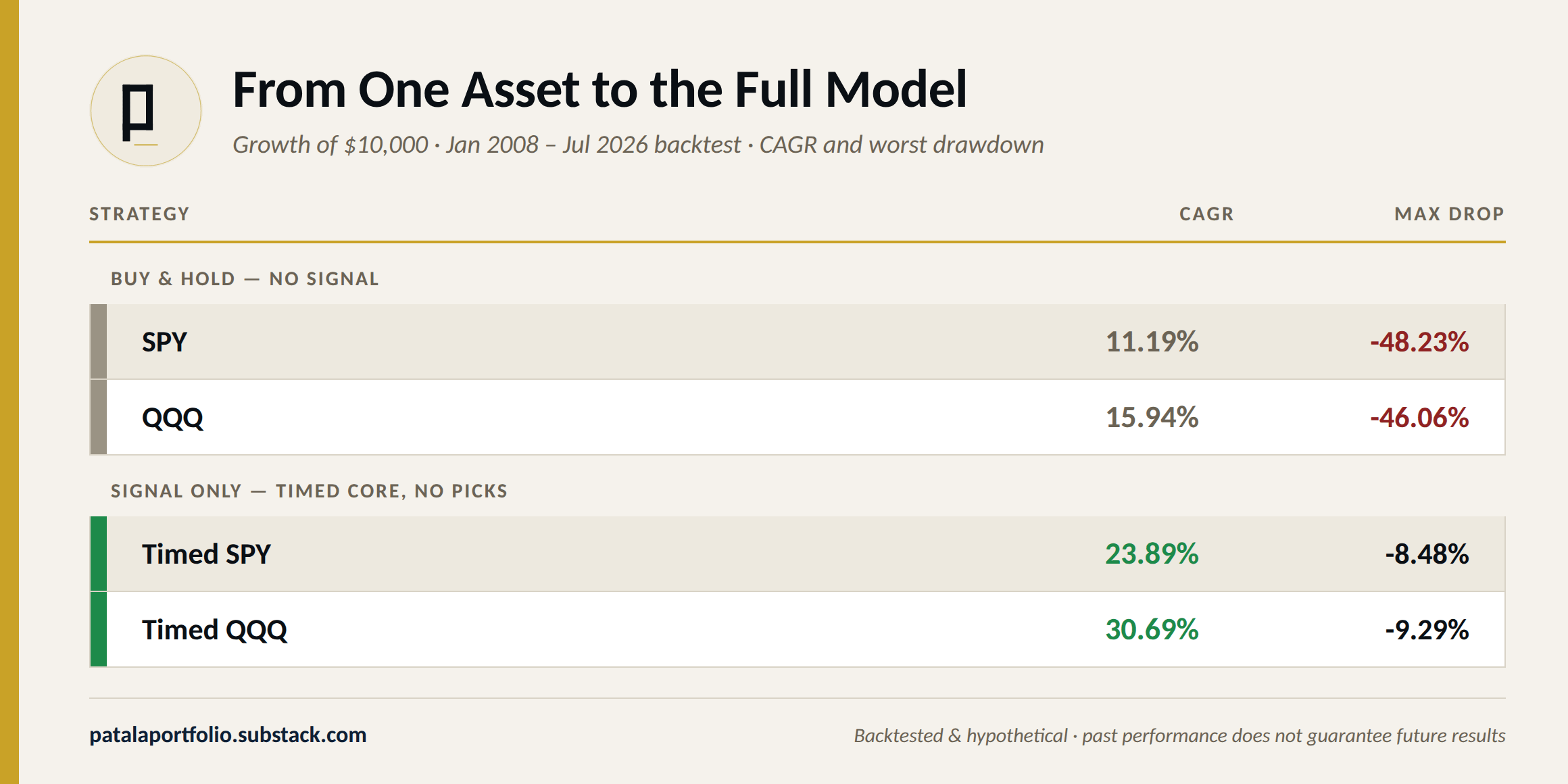
Start with the top two rows. Buy-and-hold SPY compounded at 11.2% a year — and lost 48% of its value in the 2008–09 crash. QQQ did better on return, 15.9% a year, and still gave back 46%. Those numbers understate the damage, because a drawdown isn’t just a number — it’s a length of time. SPY didn’t reclaim its old high until April 2011. That’s more than three years underwater, and it is the reason so many investors never actually collect the market’s long-run return. They sell somewhere near the bottom and come back long after the recovery.
Now add the signal. Timed SPY compounded at 23.9% a year with a worst drawdown of −8.5%. Timed QQQ reached 30.7% with a −9.3% worst drawdown. Same two ETFs, same holdings, no leverage. The only difference is sitting in cash through the worst stretches instead of riding them down.
The clearest illustration is the COVID crash. Between January and March 2020, SPY fell 19.4%. The timed version was down 0.04%.
That alone is a complete, followable strategy. If you did nothing else but run the signal on one ETF, you’d have a system most people would be glad to own. But we can do better.
Add the core: choose your engine
The single-asset version raises the obvious question: SPY or QQQ?
This is your first dial, and it’s really a question about temperament:
SPY — 500 companies, broadly diversified, steadier. The conservative core.
QQQ — 100 growth-heavy names, more volatile, higher-returning over this era. The aggressive core.
Because the signal governs either one, you can reach for QQQ’s higher returns without sitting through QQQ’s unprotected drawdowns. Unprotected, the two ETFs bottomed out within two points of each other in 2008 — down 46% and 48%. Timed, they came through under 10%. The signal is what makes the aggressive choice tolerable.
Whichever you pick becomes your core — the base your capital rides while the signal says BUY.
Add the Quant picks: one high-conviction stock a week
Here’s where the “Plus” comes in.
My model doesn’t only time the market — it also selects individual stocks. Rather than leave everything in the ETF core, I carve off a small slice for the highest-conviction name the model surfaces — one new pick a week, published every Sunday at 6:00 pm ET and bought the following Monday.
Each pick is funded by selling a small piece of the core. It’s held until the signal flips to SELL, at which point everything — core and picks alike — goes to cash together. There’s no separate exit rule for individual stocks, and no target price. The signal governs the whole portfolio.
Two limits keep this from running away with the portfolio. Each pick is capped at a fixed percentage of the portfolio, which you choose. And the stock sleeve as a whole is capped at 50% — once open picks reach half the portfolio, new picks are skipped until the next SELL clears the decks. At least half your money stays in the core at all times.
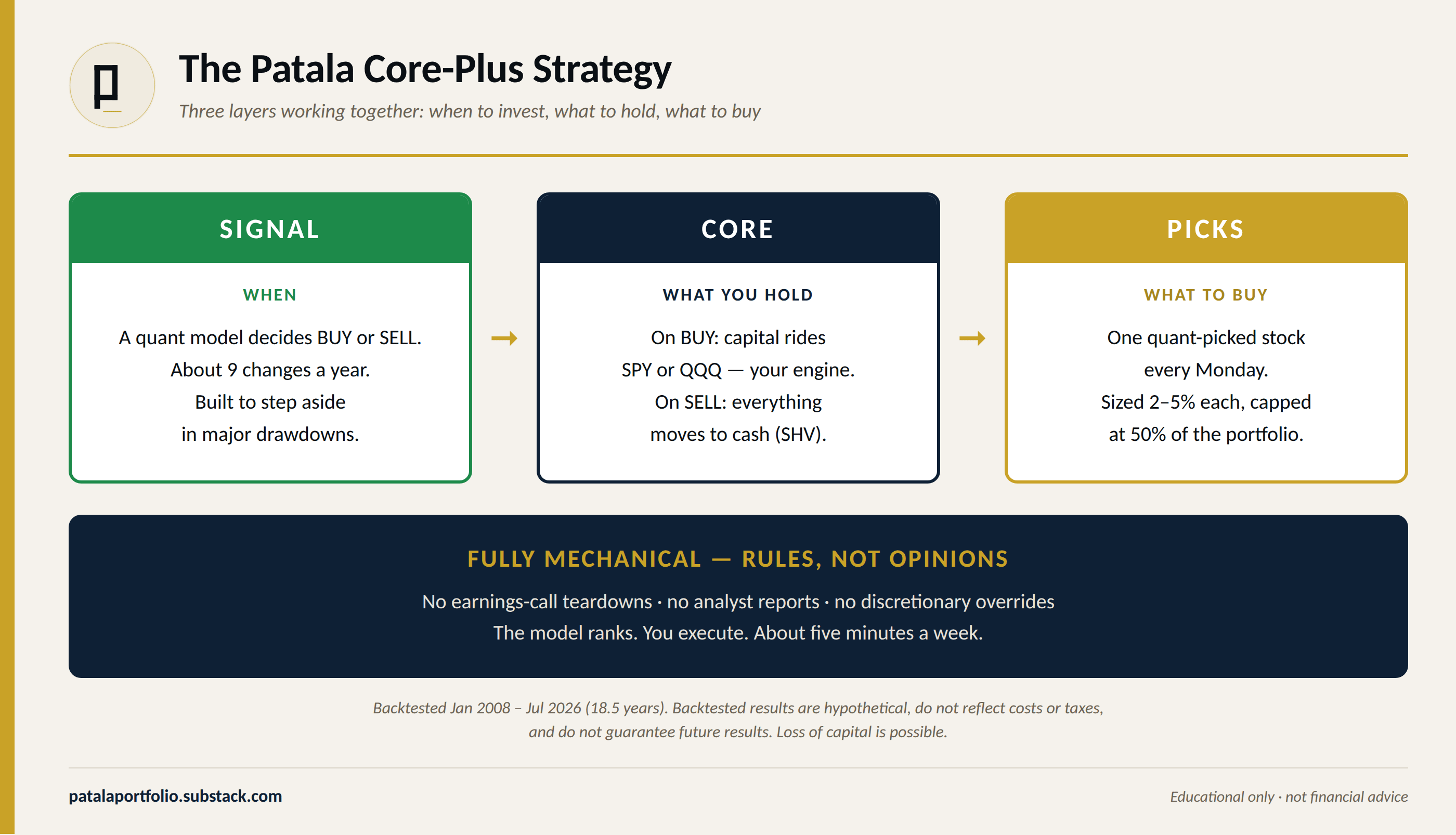
That’s the entire system: Signal, Core, Picks. When to invest, what to hold, what to buy.
What this is — and what it isn’t
This is the part I want to be blunt about, because it determines whether this newsletter is for you.
Everything here is quant-driven. The signal is a model output. So is the stock selection. I don’t override either one because I have a feeling about the tape, and I don’t skip a pick because I don’t personally like the company.
I don’t do fundamental or technical deep dives. You will not get a 3,000-word thesis on why some company is a generational buy. No discounted cash flow models, no earnings-call teardowns, no assessments of management quality, no chart patterns or support levels. That’s not what this is, and pretending otherwise would be dishonest.
What you get instead is short and mechanical:
the current signal state — BUY or SELL,
the week’s stock pick,
and the sizing rule.
Perhaps five minutes of reading and one or two trades a week.
Why build it this way? Because consistency is the thing most retail investors never achieve. Read forty analyst reports and you can reach opposite conclusions on the same stock in the same week, depending on which one you read last and what mood the market put you in. A rule doesn’t do that. A rule produces the same answer every time, including on the days you’d rather not follow it — and those are usually the days that matter most. The 2008 and 2020 columns above weren’t won by insight. They were won by a rule that said “sell” and got followed.
The honest cost of this approach: when a pick goes against me, I won’t have a satisfying story for why. The model doesn’t offer one, and I won’t invent one after the fact. If you need a narrative to hold a position, a mechanical system will be genuinely uncomfortable to follow. That’s worth knowing before you subscribe rather than after.
How much to put in each pick
The last dial is position size — each pick as a percentage of your portfolio:
2% per pick — gentle. The core does most of the work.
3% per pick — balanced. My default.
4% per pick — assertive.
5% per pick — aggressive. The Quant Stocks carry more of the load.
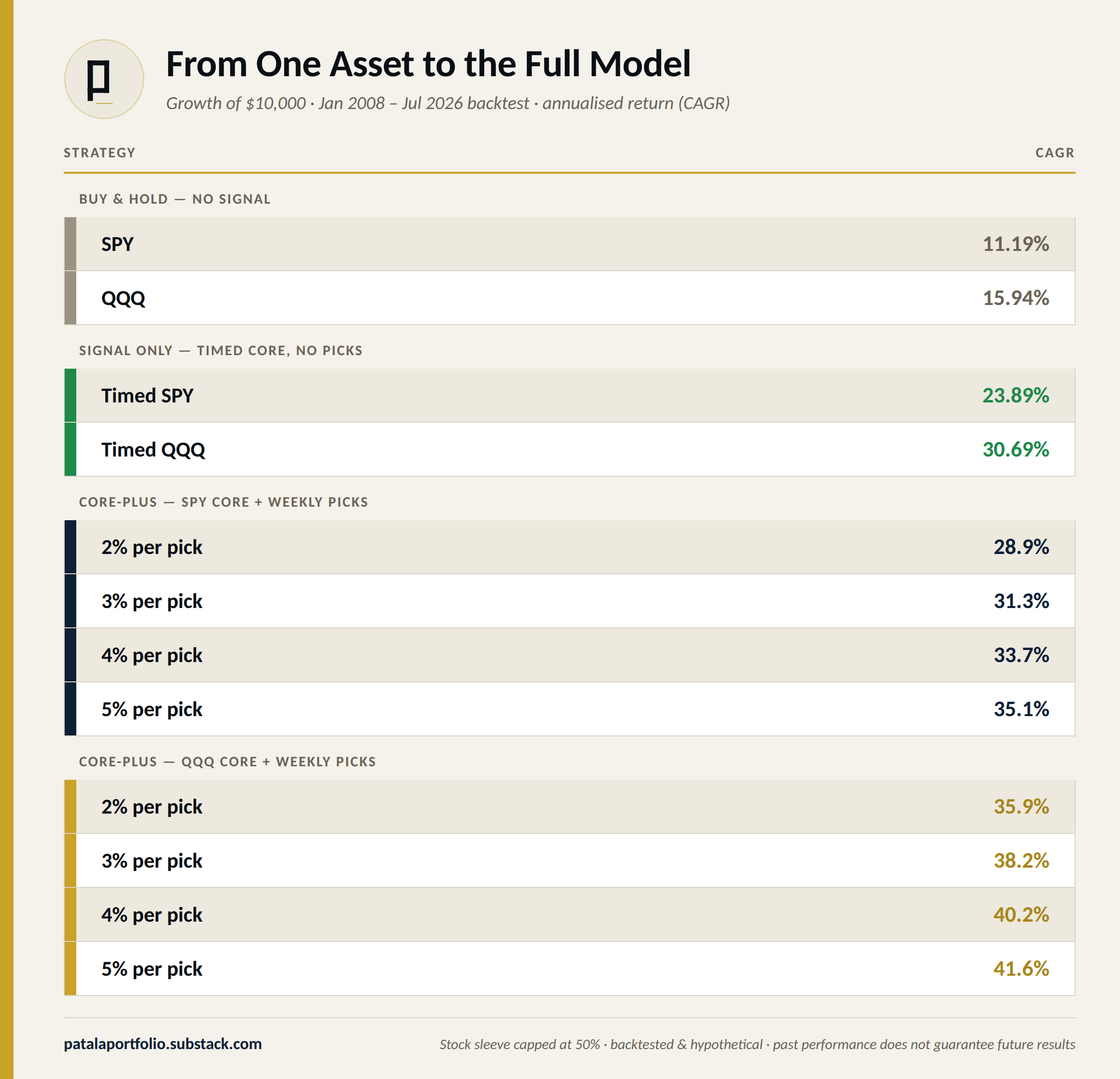
The pattern is the one you’d expect: every step up in pick size adds return, and adds concentration risk along with it. Note what the 50% cap does, though. At 2% you take nearly every pick the model produces. At 5% you hit the ceiling quickly in a long BUY stretch, and roughly a quarter of the picks get skipped because there’s no room left — which is why the last step up buys less than the ones before it. You set the dial to your own comfort, not mine.
Notice one thing, though: the timed core with no picks at all is already a serious strategy. The picks are meant to enhance a strong base, not to rescue a weak one. That’s deliberate, and it’s why the system doesn’t live or die on any single stock.
What the drawdown numbers do and don’t cover
I want to be precise about this, because it’s the easiest place for a reader to draw a false conclusion.
The −8.5% and −9.3% worst drawdowns above are for the timed ETF core only — no stock picks. They are what the signal did to SPY and QQQ, nothing more.
The Core-Plus version will be considerably more volatile, and its drawdowns will be materially deeper. Here’s why. The core is an index — hundreds of companies, one bad name barely registers. A stock pick is a single company. Most picks will be S&P 500 constituents, but not all of them; some will be smaller, less liquid, higher-growth names. Individual stocks of that kind routinely fall 30%, 40% or more on a single earnings miss, a guidance cut, or a sector rotation — and unlike the index, they don’t necessarily come back. With up to half the portfolio in a handful of such positions at once, drawdowns well beyond what the core alone experienced are not a tail risk. They should be your baseline expectation.
I’m not publishing a drawdown figure for the Core-Plus variants, because computing one honestly requires the full daily price history of every stock the model has ever picked, and I’d rather show you nothing than show you a number I can’t stand behind. What I will do is report the live portfolio’s drawdown every month, as it happens, on real money.
If a 30–40% drop in a single position would cause you to abandon the system, run a smaller pick size — or run the core alone. That option is on the table for a reason.
Why “Core-Plus”
The name is the architecture: a Core you compound in (a timed ETF), plus a sleeve of high-conviction picks on top. The signal governs both — it decides when the whole portfolio is invested and when it’s in cash.
Three layers, each with one job:
The Signal tells you when — and moves you aside in the worst stretches.
The Core is what you hold — SPY or QQQ, your choice of engine.
The Picks are what you buy — one high-conviction stock a week.
Every Sunday at 6:00 pm ET I publish the signal and the week’s quant-picked stock, free.
The schedule, and the live portfolio
Backtests are necessary, but they are not proof. A backtest is a description of a period that already happened, built with full knowledge of how it turned out. So from Monday 10 August 2026, I’m running The Patala Live Portfolio — a real, funded account, my own money, invested in this exact Core-Plus strategy, with results I’ll report every month.
The weekly rhythm is fixed:
Sunday, 6:00 pm ET — I publish the current signal state and the week’s quant-picked high-conviction stock.
Monday — I buy it in the live portfolio. If Monday is a market holiday, the trade moves to Tuesday.
Same time, every week. You’ll have the pick in hand the evening before I act on it, with the whole of Sunday night to decide what — if anything — you want to do with it.
You get the pick before I act on it, not after. That ordering is deliberate and it will not change.
I’ll report allocations and percentages, not dollar amounts. You’ll see the signal state, the core and how much is deployed, and each open pick with its position size and return — all as percentages of the portfolio. What you won’t see is my account balance, because it isn’t useful to you. Whether you’re running $5,000 or $5,000,000, what transfers is the allocation, not my personal balance.
Each monthly report will show:
The current signal — BUY or SELL — and how long it’s been in that state
The core allocation, the stock sleeve, and the cash position
Every open pick: its position size and its return
The month’s return, the cumulative return since inception, and the worst drawdown so far — in percent
One promise: you’ll see all of it. The winning months and the losing ones, the picks that work and the ones that don’t. A track record you only see when it’s flattering isn’t a track record.
What to expect
Let me set expectations plainly, because that matters more than enthusiasm:
The numbers above are backtested and hypothetical. They’re a simulation over one historical window — January 2008 to July 2026 — with no trading costs, no slippage and no taxes. That window contains one enormous crash near the start and a long, unusually strong run for U.S. large-cap growth after it. A different 18 years would produce different results. Past performance does not guarantee future results. A live return well below the backtest would still be a reasonable outcome, and it’s the one I plan around.
The edge depends on the signal continuing to work and on the stock selection holding up. I believe both will — that’s why my own money is in it — but belief isn’t evidence, and a model that worked across one historical window can stop working in the next one.
You can lose money doing this, including a substantial amount. The signal reduced drawdowns in testing; it does not eliminate them, and it cannot protect against a fast crash between weekly readings. Individual stock picks can fall hard and can go to zero. Nothing here is capital-protected.
Some months will be red. Some picks will be losers. The signal will whipsaw — flipping to SELL just before a rally, or to BUY just before a drop. The backtest shows plenty of those. That’s normal for a timing model, and I’ll report it plainly when it happens.
This is education, not advice. I don’t know your income, your tax situation, your time horizon, or your other holdings — and without those, no one can tell you what belongs in your portfolio.
What I can offer is a disciplined system, run transparently, with my own capital on the line, and the honesty to show you exactly how it goes.
The signal tells you when. The core compounds. The picks add the edge. From Monday, you can watch it happen in real time.
Disclosure: I personally invest in the positions discussed in The Patala Live Portfolio, including every weekly pick. Picks are published to all subscribers on Sunday at 6:00 pm ET, and I place my own trades on the following Monday — that is, always after publication, never before.
Disclaimer: I am not a registered investment adviser, broker-dealer, or financial planner, and nothing in this publication is personalized investment advice, a recommendation or solicitation to buy or sell any security, or an offer of advisory services. This publication is provided for educational and informational purposes only. All performance figures shown are backtested and hypothetical; they are derived from the retrospective application of a model to historical data, do not represent actual trading, and do not reflect trading costs, commissions, slippage, or taxes. Hypothetical results have inherent limitations, including the benefit of hindsight, and results may vary with each use and over time. Past performance — whether backtested or live — does not guarantee or indicate future results, and future results may be materially worse. Investing in equities and ETFs involves substantial risk, including the possible loss of some or all of your capital; a market-timing model does not prevent losses and may underperform a simple buy-and-hold approach for extended periods. Concentrated positions in individual equities — including smaller, less liquid, or high-growth companies — carry materially greater risk of large loss than a diversified index fund. Asset allocation and diversification do not guarantee a profit or protect against a loss. The Patala Live Portfolio reflects one individual’s account and is shared for illustration only. You should not rely on this publication as the basis for any investment decision. Consult a qualified, licensed financial adviser who understands your full circumstances before investing. You are solely responsible for your own investment decisions and their outcomes.
This is truly fantastic news worth all yr efforts
I like the idea of separating the portfolio into clear roles. Having a framework for what each bucket is supposed to do makes it much easier to stay disciplined when markets get noisy.