

This week’s signal. This week’s pick. What to do with both.
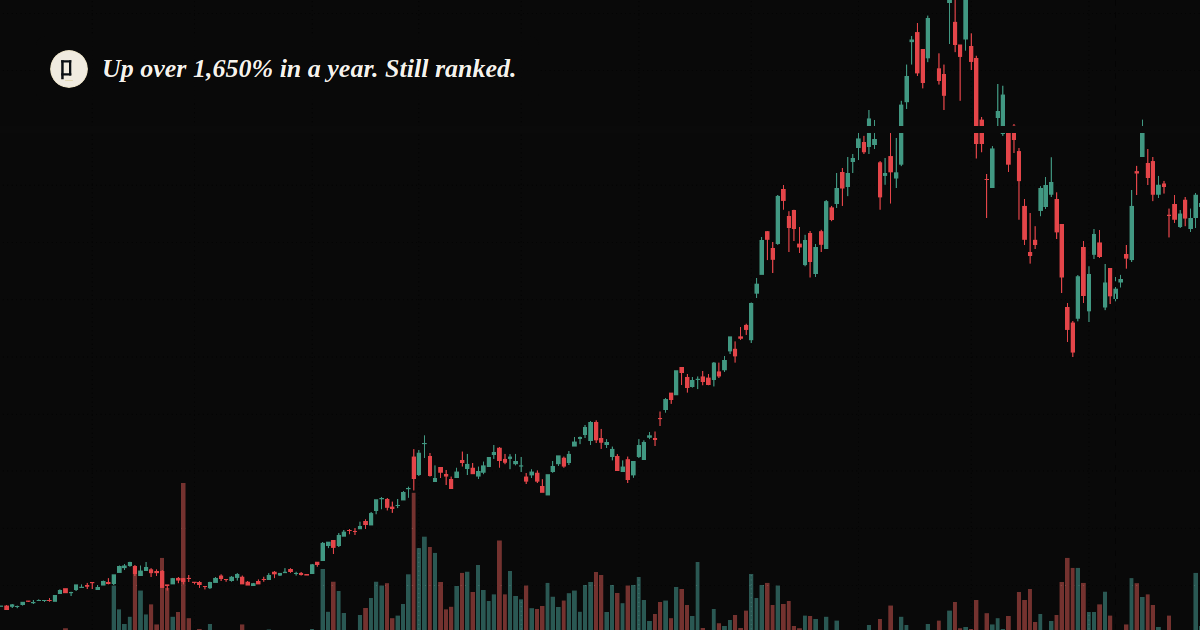
Eighteen months ago, this company didn’t exist as a standalone stock. It was spun out of a much larger parent, started trading on its own at roughly $35 a share, and looked, on paper, like a forgettable memory-chip afterthought.
It is now up more than 1,650% in a single year.
It has been at the center of one of the most dramatic hedge fund blowups — a $20 billion AI fund built a five-and-a-half-billion-dollar position in it, then got margin-called and force-liquidated the entire thing to a rival in a single block trade. The stock cut nearly in half in weeks, for reasons that had nothing to do with the business itself.
And on the exact same day I’m buying it, it’s joining the S&P 100 — the index’s blue-chip inner circle, a step up from the S&P 500 it already entered last November.
My model doesn’t know any of that. It doesn’t read hedge fund 13Fs, doesn’t track forced liquidations, doesn’t have an opinion on index inclusion. It just ranks all 450+ stocks the same quantitative way, every week — and this week, this one landed at #3.
Signal: BUY.
Capital stays invested — core and pick both.
Subscribe for free to see this week’s pick — the name, the numbers, and the wild story behind the chart.
What makes this especially interesting is the separation between the extraordinary story and the signal itself. A 1,650% rise, forced liquidation and index inclusion are almost impossible for a human investor to view without emotion—yet the model simply ranks what is in front of it. That discipline is valuable. The real test now, however, is whether the ranking captures continuing fundamental and price strength or merely rewards an already extreme move. I would be particularly interested in how valuation, reversal risk and position sizing enter the process here. A fascinating pick—and probably the clearest possible demonstration of both the strength and the psychological difficulty of following a quantitative system.