

Welcome to my second monthly portfolio update. I launched this newsletter at the end of July and published my first live signal on July 26. My track record started from scratch in August, and I report it live every month.
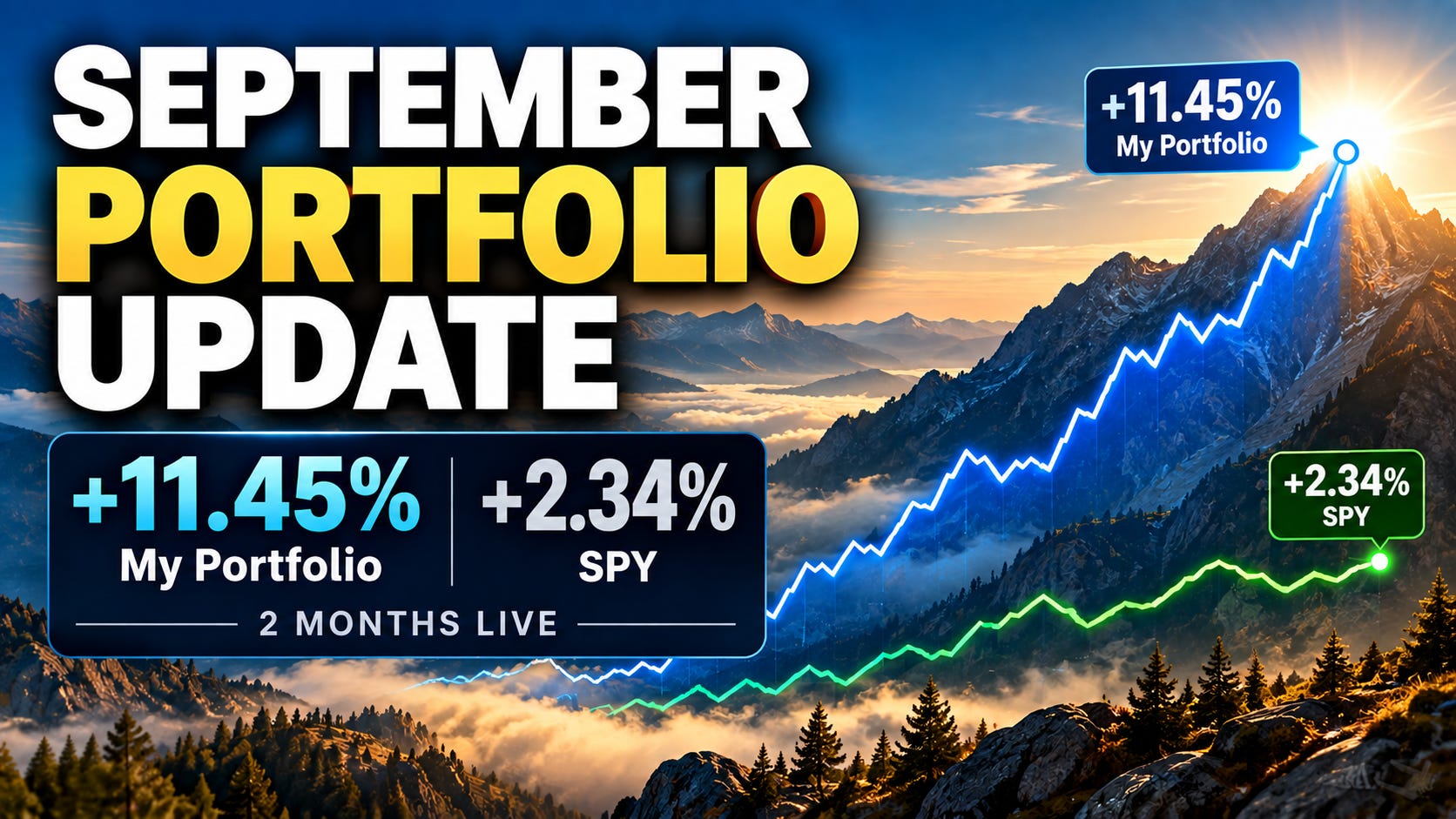
Since I started tracking, the account is up +11.45% against +2.34% for SPY.
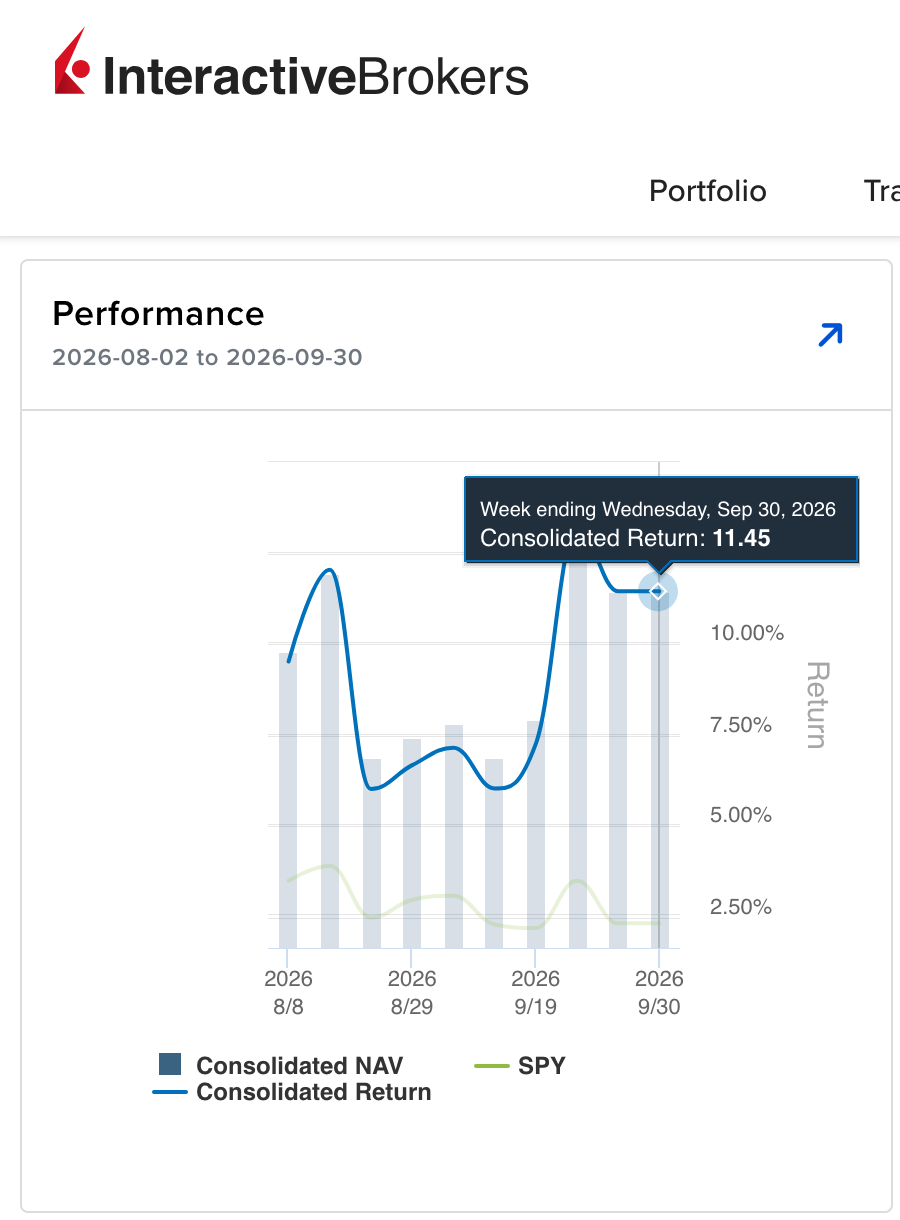
August: +6.80%
September: +4.36%, while SPY finished slightly lower
The stock picks: I also track every QuantRanks pick I’ve published, assuming $1,000 into each at the Monday open. That’s 8 buys so far, up +11.81% as of September 30. The same $1,000 buys in SPY are down -0.69%. Five of the eight beat SPY. The full scorecard is in Part 2.
A few things worth knowing before those numbers get too much credit:
No money was added or withdrawn. This is pure trading performance.
It wasn’t a smooth ride. In September the account fell to roughly -3% by mid-month, then climbed past +5% before closing at +4.36%. Systematic doesn’t mean comfortable. It means staying in your seat.
A note on August’s number: My August update reported +8.14%, taken from the IBKR mobile app. This update uses IBKR’s Consolidated Return report for every period, so the months tie together. August is restated to match.
How these updates work: Every monthly update has two parts. Part 1 explains how the strategy works. It’s the same every month, so skip ahead if you’ve read it. Part 2 is the deep dive: what’s in the account, what changed, and how the picks are doing.
Part 1: The Strategy (this section runs every month, unchanged)
One signal. That’s it.
Everything in this portfolio comes down to one quant timing signal, built over twenty-plus years. It has two parts:
A macro model that makes one BUY or SELL call on the first trading day of each month.
A daily model that splits the market into 158 zones. Only 11 trigger a SELL, so the signal stays invested through normal ups and downs and steps aside only when things get genuinely dangerous.
The signal flips about 9-12 times a year. That’s the whole job: check it, act if it flips, sit tight the rest of the time.
Backtested, and verified independently through Portfolio Visualizer:
SPY, since January 2000: a hypothetical $10,000 grows to $1.75 million, with a worst drawdown of just -8.5%, versus -50.8% for buying and holding.
QQQ, same 26+ years: $10,000 grows to $9.2 million (29.28% a year) versus $90,406 for buy-and-hold (8.64%). It also sidestepped the dot-com crash’s 81% collapse, with a worst drawdown of only -9.97%.
The signal doesn’t win by picking better stocks. It owns the same index either way. It wins by not being there for the crashes.
The Core: your engine
You choose what the signal drives:
SPY: 500 companies, broadly diversified, steadier. The conservative choice.
QQQ: 100 growth-heavy names, more volatile, historically higher-returning. The aggressive choice.
Whichever you pick becomes your Core, the position you hold whenever the signal says BUY.
For those who want to go further, the same signal on TQQQ (a 3x-leveraged Nasdaq-100 fund) turned a hypothetical $10,000 into $1.56 billion over a 16-year backtest (2010-2026), versus $3.2 million for buy-and-hold. Some honest caveats:
It’s a hypothetical backtest, not real trading.
The window starts near the bottom of a historic bull run.
Leverage decays in choppy, sideways markets.
This isn’t a recommendation to hold 3x leverage unhedged.
Still, the mechanism is the same: the signal’s worst drawdown on TQQQ was -26.03%, versus a 79.08% buy-and-hold collapse in 2022.
The Plus: one high-conviction stock a week
On top of the Core sits QuantRanks, the stock-picking half of the model:
Every Sunday at 7:00 am ET, I publish the week’s top-ranked pick from 450+ stocks.
I buy it Monday, funded by trimming a slice of the Core.
I hold it until the signal flips to SELL, when Core and picks all go to cash together. No price targets, no separate exit rules.
Two guardrails keep the stock sleeve in check:
Each buy is typically about 3% of the portfolio. If a name keeps reappearing in the top picks, I keep adding to it.
The sleeve is capped at 50%, so at least half the book stays in the Core.
Why “Core-Plus”
Three layers, three jobs:
The Signal decides when: invested or in cash.
The Core decides what you hold: SPY, QQQ, or a leveraged version.
The Picks decide what you add: one high-conviction stock a week.
The Patala Live Portfolio runs this exact system with my own money. I report allocations and percentages, not dollar amounts, so what transfers to you is the strategy, not my account size.
Full backtests and methodology: The Simplest Investment System in the World · $10,000 in the Nasdaq Since 2000 · Same Signal + 3x the Leverage · The Patala Core-Plus Strategy
What’s inside Part 2
Here’s the full breakdown of how my portfolio stood on September 30: every asset and its exact weight in the book, plus the scorecard for every pick. The Core is the same four ETFs as last month. The Plus sleeve now holds six QuantRanks stocks, two of them new.
Subscribe free to unlock the full portfolio
A free subscription gets you:
Weekly trade signals on SPY, BTC, and GLD + real-time flip alerts.
The stock I buy every Monday.
Monthly live portfolio performance & all holdings.