

Reality check first: If the returns in the title look a little absurd, it is because they are. A major portion of the 8,484x return happened in 2016-2017, when Bitcoin’s market cap was under $20B. It’s over $1.5T now. That kind of percentage move doesn’t repeat at this size. Read this for what the signal did to the drawdowns — not as a promise the next ten years look like the last ten.
Bitcoin is too chaotic to trade with rules, right?
A quantitative signal turned Bitcoin’s worst drawdown from -75.57% to -43.00%, while still compounding at 135% a year.
Bitcoin doesn’t just crash in a panic. It’s had nine drawdowns of 7%+ since 2016, including two multi-year stretches that erased 73-76% of buy-and-hold value. The damage isn’t the crash — it’s the year-plus grind back to even.
That’s why this signal exists. Not to predict Bitcoin’s next move. Just discipline for when to be in it, and when to step aside.
Subscribe Free For Live $BTC Trade Signals.
$10,000, Bitcoin, two paths, ten years
Same BTC. Same $10,000. One line holds it. The other follows the signal — in on BUY, cash on SELL.
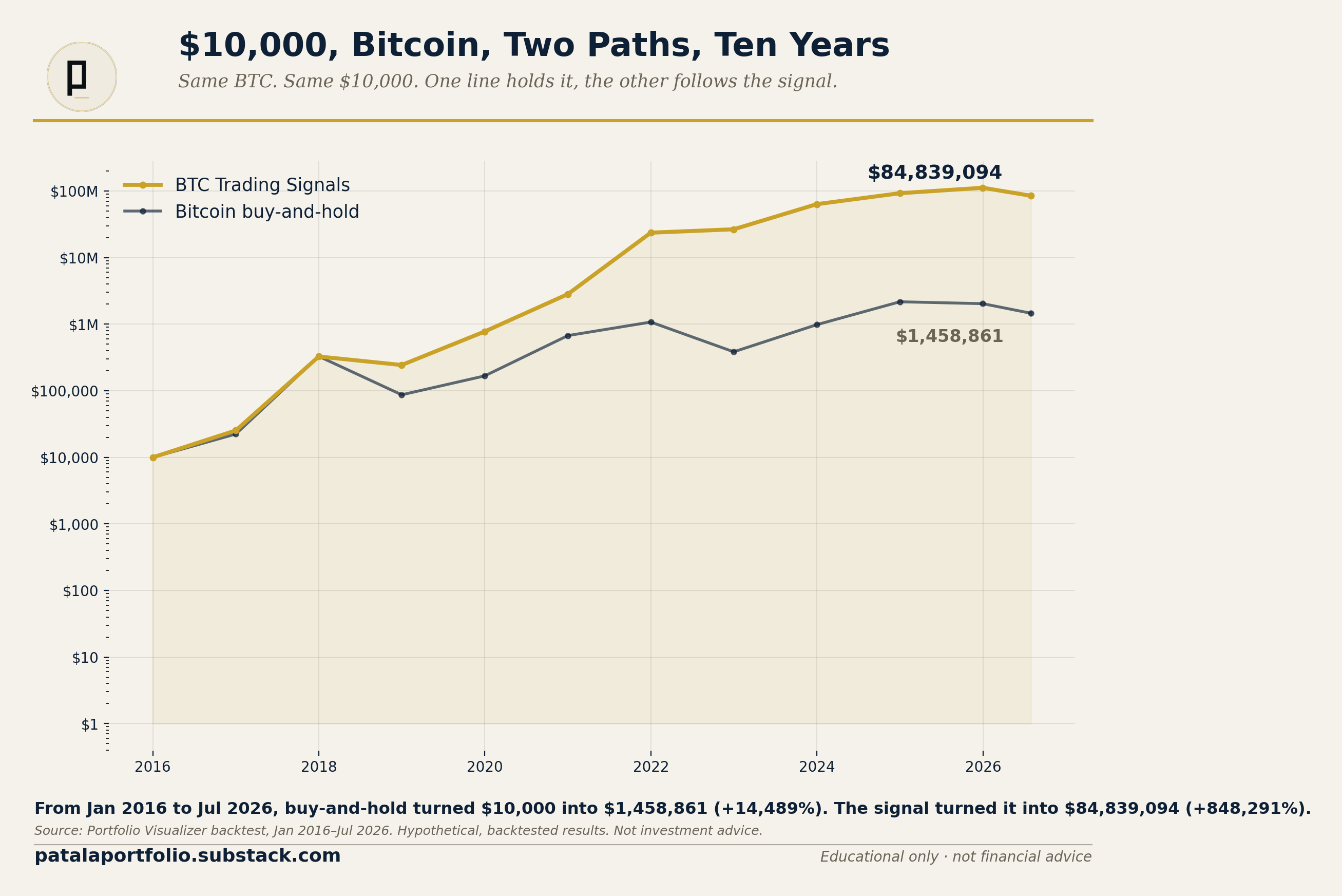
Jan 2016 to Jul 2026: buy & hold turned $10,000 into $1,458,861. The signal turned it into $84,839,094 — 58x more ending wealth, same asset, same starting dollar. Adjusted for inflation, that’s still $60.1M vs. $1.03M — the gap isn’t a nominal-dollar illusion.
The gains are nice. The drawdowns are the point.
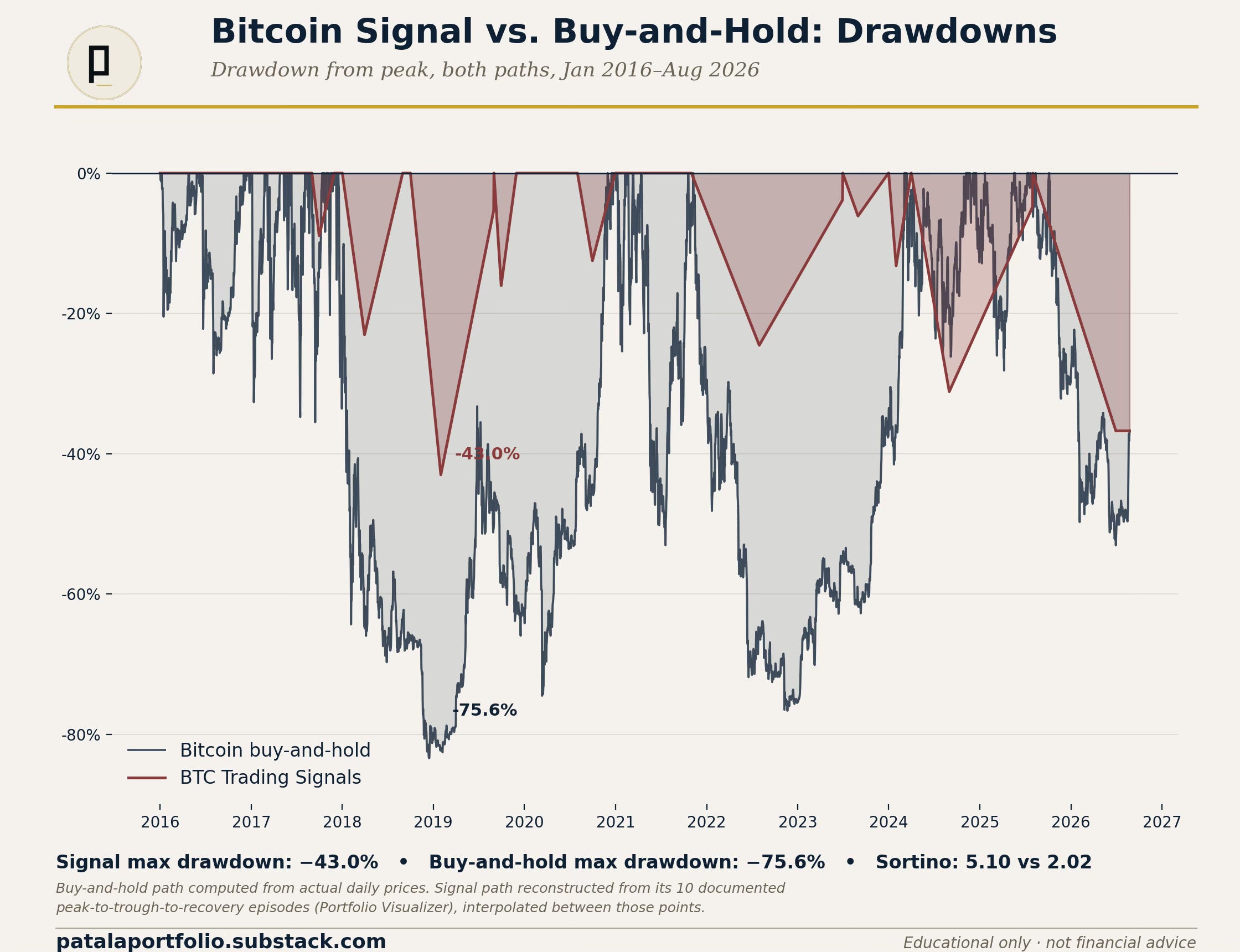
Buy-and-hold Bitcoin has been cut in half or worse twice since 2016 — 75.57% in 2018, 73.01% in 2021-2022. The signal’s worst: -43.00%, recovered in 8 months. Across all nine completed drawdowns, the average time back to breakeven was under 6 months — the one exception is the current stretch, still underwater since August 2025.
The full dashboard, no cherry-picking
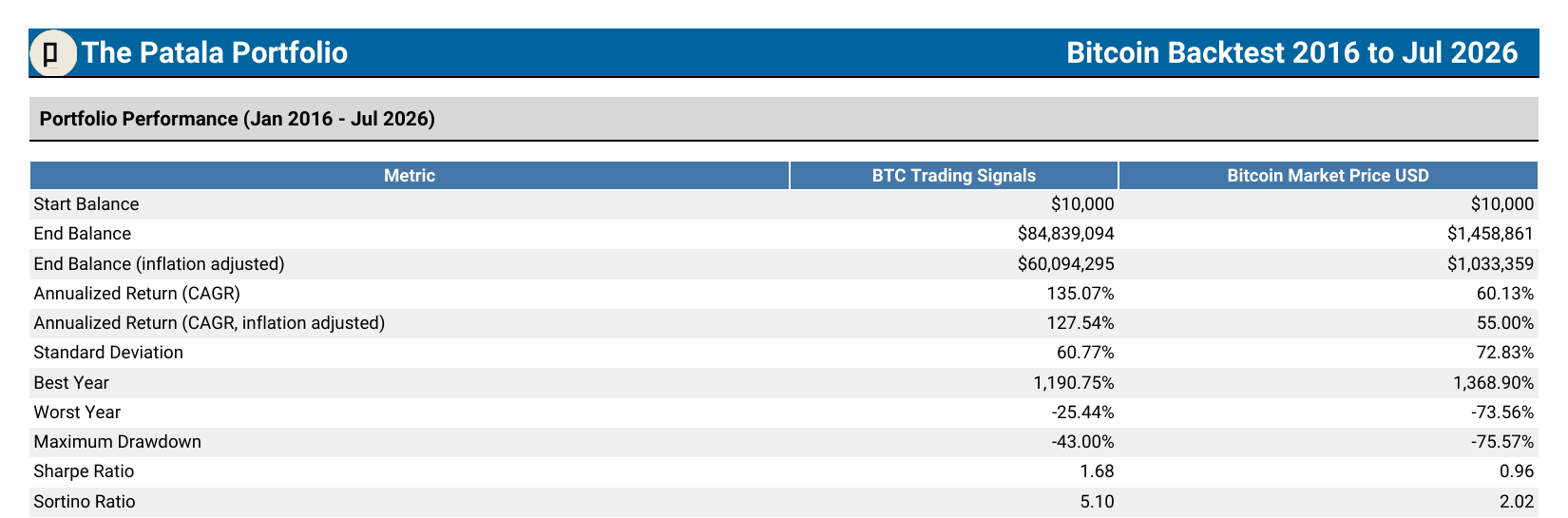
Better risk-adjusted return, shallower worst-case, at the same time. Verified in Portfolio Visualizer — not a spreadsheet model.
A few numbers from that table worth translating out of finance-speak: standard deviation (60.77% vs. 72.83%) means the ride itself is smoother, not just the worst day. Benchmark correlation of 0.81 means the signal still moves with Bitcoin most of the time — this isn’t a market-neutral strategy, it’s a better-timed version of the same asset. And an information ratio of 1.77 — the return earned per unit of tracking error versus just holding Bitcoin — is the kind of number that’s rare to see outside of quant funds with a lot more infrastructure than a weekly newsletter.
Annual returns, Jan 2016-Jul 2026
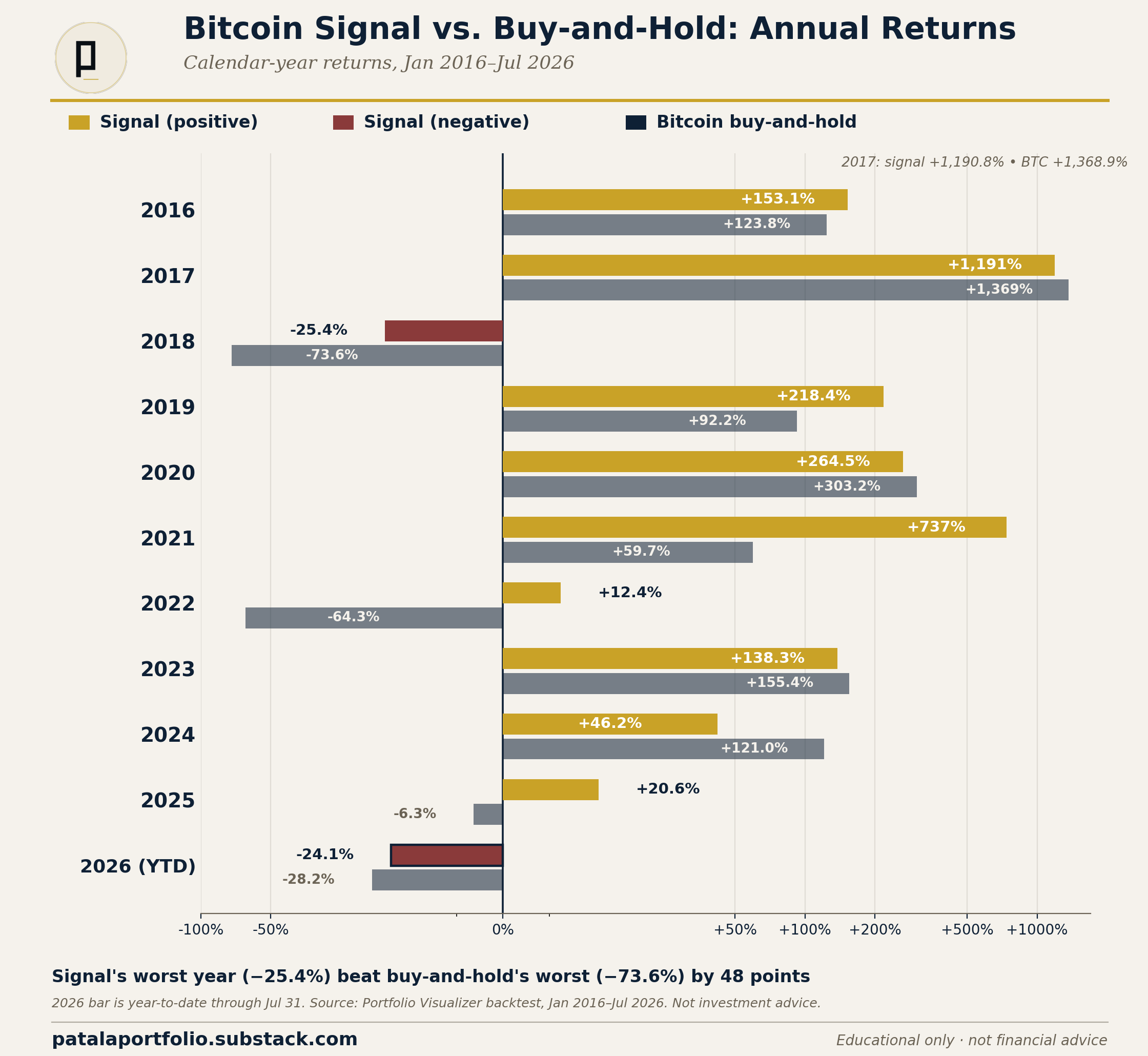
Four red years across eleven. Every one shallower than buy-and-hold’s equivalent down year. 2017 and 2021 show it kept pace on the good years too.
This is the kind of update most newsletters wait out. Subscribe if you want these, not just the highlight reels.
How it works
Simple. No screen-watching. I publish the signal so you always know the position.
One honest note: this is a high-turnover system — about 69 trades a year, median hold 3 days. Bitcoin just moves faster than stocks or gold. Flip alerts go out same-day, not weekly.
Another one: there are no stop-losses. I’ve tried them, and they’ve never worked for me — they get whipsawed out of positions right before the move you were waiting for. The only exit is the signal itself flipping. If it says stay in, you stay in, drawdown and all.
What’s next
Live BTC signals start Saturday, August 29 — alongside SPY and GLD, flip alerts the moment the position changes.
Already published: SPY backtest · QQQ backtest · TQQQ backtest · GLD backtest
Same rules. One asset that never closes. Same discipline either way.
Subscribe free to follow The Patala Live Portfolio
Disclaimer: I am not a registered investment adviser, and nothing here is personalized investment advice, a recommendation, or an offer of advisory services. This publication is for informational and educational purposes only. Performance figures are backtested using historical data and a mechanical application of the signal rule described above, verified independently in Portfolio Visualizer; backtested results are hypothetical, have inherent limitations, and do not guarantee future results. The strategy’s ~725 trades across the backtest period do not reflect transaction costs, slippage, or tax drag, all of which would reduce real-world returns. Past performance — backtested or live — does not guarantee future results. Bitcoin and other cryptocurrencies are highly volatile and speculative assets. Consult a qualified financial adviser before investing. You are solely responsible for your own decisions.